
What is DISC?
When you understand your natural behavioral style and recognize others’ preferences, you can start to treat others the way they want to be treated. Discover how DISC supports learn more about the four, DISC Personality Styles.

The DISC assessment is a non-judgmental behavior measurement tool used by over 50 million people worldwide to improve self-awareness, communication, and workplace collaboration.
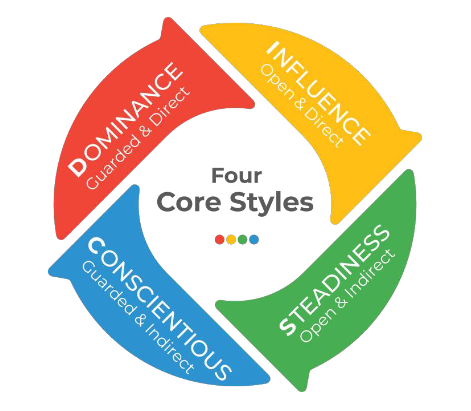
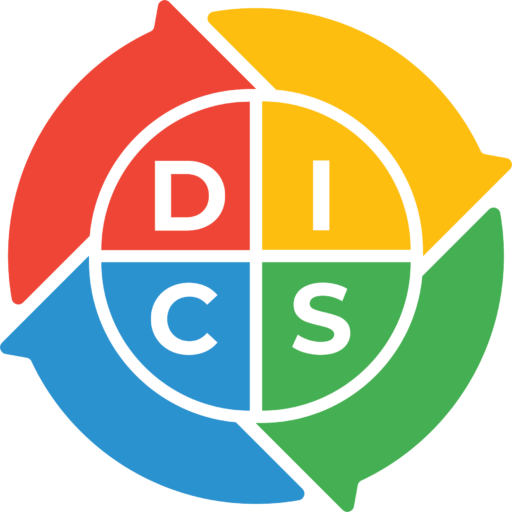
Based on William Moulton Marston’s behavioral theory, the DISC behavior model categorizes human behavior into four primary personality styles: Dominance (D), Influence (I), Steadiness (S), and Conscientiousness (C).
Organizations use DISC profiling to decode natural behavioral preferences, reduce team conflict, and adapt communication styles in real time. Rather than measuring intelligence, aptitude, or mental health, a DISC personality test measures how you react to problems, influence others, handle pace, and respond to rules.
Key Statistics & Industry Impact
Global Reach: Over 75% of Fortune 500 companies utilize DISC assessments to develop leaders and enhance team dynamics.
Accuracy & Consistency: Validated by the Assessment Standards Institute (ASI), our DISC assessments boast reliability scores over 90% across diverse workplace demographics.
Rapid Completion: Our standard DISC test takes only 15 to 20 minutes to complete.
Get Started With DISC Basic
We offer a free DISC Assessment so you can learn your style and experience the assessment process. Upgrade your report to unlock additional insights, or schedule a call to discuss your unique learning objectives.
Take the Free AssessmentSchedule a DemoWhat Does DISC Measure?
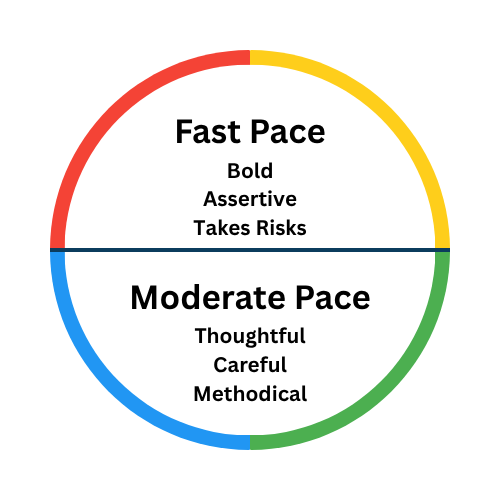
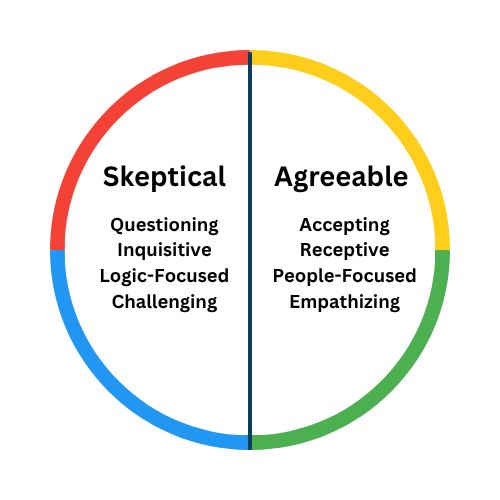
A DISC profile provides a clear picture of a person’sbehavioral style and communication preferences. At its core, the model evaluates behavior along two intersecting axes:
Pace Scale
Trust Scale
Four Core Styles
Pace & Assertiveness:
Fast-Paced / Active: Quick decision-makers who take risks and move quickly and assertively.
Moderate-Paced / Thoughtful: Methodical thinkers who prefer steady environments and gathering details before acting.
Trust & Focus:
Questioning / Task-Focused: Logical, analytical thinkers who challenge ideas to uncover flaws.
Accepting / People-Focused: Empathetic, relationship-oriented thinkers open to collaboration and consensus.
Each individual axis combines to create Four Main DISC Personality Types.
How does DISC work?
Taking a DISC assessment is a simple three-step process that delivers actionable workplace insights:
| Phase / Step | What Happens | Output / Result |
|---|---|---|
|
Step 1: Online Questionnaire |
Answer a series of questions rating how well different, descriptive words apply to you in a workplace context (15 – 20 minutes). |
Raw behavioral data collected |
|
Step 2: Profile Generation |
Advanced algorithms analyze responses to plot your DISC behavioral graphs and generate your style description. |
Personalized DISC Profile report is produced |
|
Step 3: Application & Action |
Learn your DISC personality meaning, recognize the styles of colleagues, and practice DISC interpretation Dos and Don’ts to adapt your approach. |
Improved communication & collaboration |
Common Questions Answered!
Taking a DISC assessment is easy and takes on average 18 minutes to complete.
DISC is one of the most researched and used assessments today. It is highly accurate and well-understood by the academic and psychometric community who determines assessment accuracy.
The DISC Basic assessment is validated by an outside, third party organization to ensure it is both accurate and reliable.
Every 5-years, we re-validate our assessment to ensure the accuracy and reliability is consistent.
There are no ‘right’ or ‘wrong’ answers when completing a DISC assessment. For that reason, you can’t fail it!
The Four DISC Personality Types Explained
Every individual is a unique blend of all four styles, but most people show strong preferences toward one or two of the four primary styles: D, I, S, or C.
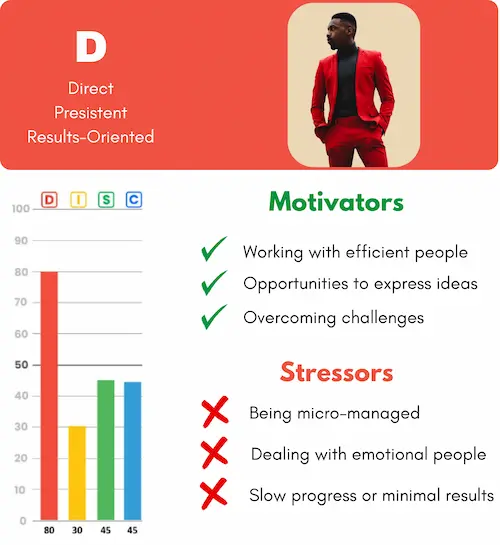
Dominance (D)
Direct, Decisive, Results-Oriented.
Core Focus: Overcoming obstacles, driving results, and taking immediate action.
Key Traits: Assertive, competitive, strong-willed, and high-energy under pressure.
Communication Style: Brief, direct, and focused on outcomes.
👉 Deep Dive: Understanding the ‘Dominance’ DISC Type
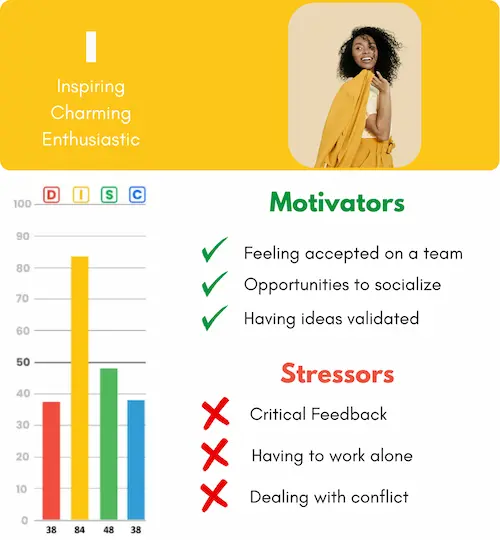
Influence (I)
Optimistic, Outgoing, Persuasive.
Core Focus: Building relationships, inspiring enthusiasm, and persuading others.
Key Traits: Enthusiastic, charming, collaborative, and expressive.
Communication Style: Lighthearted, engaging, and personal.
👉 Deep Dive: Understanding the Influence DISC Personality Type
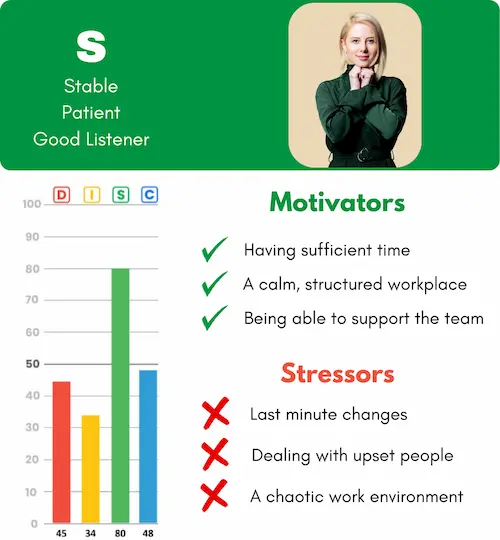
Steadiness (S)
Cooperative, Patient, Reliable.
Core Focus: Creating stability, supporting teammates, and maintaining harmony.
Key Traits: Calm, dependable, strong listener, and steady worker.
Communication Style: Warm, patient, and non-confrontational.
👉 Deep Dive: Understanding the Steadiness DISC Type
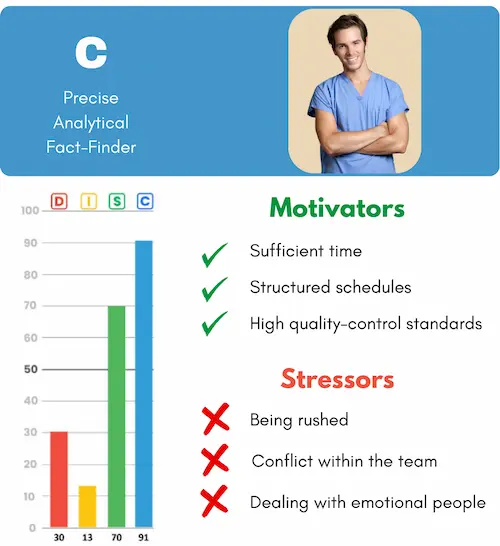
Conscientiousness (C)
Analytical, Precise, Systematic.
Core Focus: Ensuring quality, maintaining accuracy, and analyzing data.
Key Traits: Detail-oriented, cautious, systematic, and diplomatic.
Communication Style: Fact-based, structured, and precise.
👉 Deep Dive: Understanding the Conscientiousness DISC Type
Get Started With DISC Basic
We offer a free DISC Assessment so you can learn your style and experience the assessment process. Upgrade your report to unlock additional insights, or schedule a call to discuss your unique learning objectives.
Take the Free AssessmentSchedule a DemoThe 12 Blended DISC Styles
Rarely is someone purely a single letter. Primary styles combine with adjacent traits to form 12 distinct DISC behavioral patterns (e.g., Di, Si, Cd).
👉 Explore the full breakdown: What are the 12 DISC Personality Types?

Benefits of DISC
Effective Teamwork
Stronger Leadership
Better Communication
for Organizations
Conflict Resolution: Utilize DISC for conflict resolution in the workplace to de-escalate friction productively.
Seamless Onboarding: Leverage DISC to improve your onboarding process for quicker new-hire integration.
Team Development: Elevate performance through targeted team coaching with DISC.
Stronger Leadership: Help managers adapt their leadership styles to get the best out of diverse teams.
for Individuals
Enhanced Self-Awareness: Identify your natural strengths, stressors, and blind spots.
Improved Communication: Learn how to improve communication using DISC styles with different personalities.
Career Growth: Understand the environments where you naturally thrive and excel.
How DISC Compares to Other Assessments
Today, many assessments aim to help resolve interpersonal conflict and improve team and workplace culture. Here is a quick overview of what’s available based on the most popular assessments today:
| DISC Profile | Myers-Briggs (MBTI) | CliftonStrengths |
|---|---|---|
|
Primary Focus: Observable Behavior & Communication |
Primary Focus: Internal Cognitive Preferences |
Primary Focus: Innate Talents & Strengths |
|
Simple & Practical (4 Core Letters) |
Complex (16 4-letter types) |
Detailed (34 strength themes) |
|
Application: Immediate behavior modification & team building |
Application: Deep personal reflection & career matching |
Application: Talent maximization & coaching |
We believe different assessment models can work together, and we’ve written extensive guides showing how they differ and how they can work together.

How does DISC compare to Myers-Briggs (MBTI)?
In 2009, I was first introduced to the Myers-Briggs self-assessment....
Read More
How does DISC compare to Gallup’s CliftonStrengths
CliftonStrengths and DISC are both self-awareness tools that are designed...
Read MoreDISC Basic Profile Comparison
Explore our complete catalog of assessment reports tailored to your specific organizational goals:
| Application Area | Best DISC Report | Description |
|---|---|---|
|
Workplace |
Comprehensive evaluation of natural and adapted behaviors for individuals and teams. |
|
|
Emotional Intelligence |
Combines behavioral tendencies with EQ awareness for empathetic leadership. |
|
|
Motivation & Values |
Uncovers both how a person behaves (DISC) and why they take action (Motivators). |
|
|
Professional Mastery |
Become a certified DISC administrator to facilitate workshops and lead team coaching. |
Assessment Standards & Psychological Validity
Not all assessments are created equal. Online DISC Profile tools undergo rigorous testing to ensure fairness, reliability, and accuracy across all demographics.
Validated Accuracy: Audited independently by the Assessment Standards Institute (ASI) to ensure zero disparate impact.
Consistency Over Time: Learn more about stability in our research guide: Do DISC Assessment Results Change Over Time?.
Historical Grounding: Built upon decades of psychological research—read the full story in our DISC History guide.
Get Started with DISC Basic
Take our Free DISC Assessment
We offer a free DISC Assessment so you can learn your style and experience the assessment process.
After completing the assessment, you will have the option to upgrade your report to the full profile for the same price as the regular DISC Basic Full Profile.
Request a Demo
"*" indicates required fields